
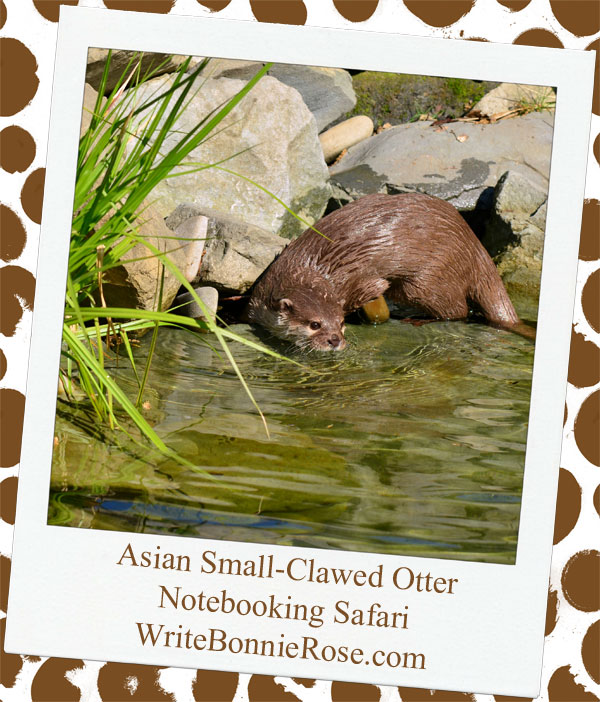
 Our next stop in our notebooking safari across Asia takes us to Bangladesh. If you’re new to the notebooking safari, visit our first stop here.
***
I thought it was time for a cute, playful animal, and what’s more fun to watch than an otter? We’re going to meet the Asian small-clawed otter, to be exact. It’s the smallest of the thirteen species of otters; they only weigh about 6.6 pounds (3 kg). That’s less than most human babies weigh when they’re born!
They are usually lots of fun to watch. Let’s go down by the river and see what they are up to.
Yep, there they are, just like I expected. There are about a dozen of them over on the far bank of the river. Do you see the patch of brown furry creatures? Here, use my binoculars. Do you see them now?
A couple of them are swimming while the others are resting on the land. Hand me the binoculars again for a minute; I think I see something you won’t want to miss.
It’s just like I thought. Here, take the binoculars back. Now, do you see the one over on the far left? He’s getting his dinner ready. He’s dug up some shellfish and is setting them out in the sun. The heat will do the work for him, causing them to open. Then he’ll just reach in and have his meal!
And don’t miss the one over on the right. He’s using the muddy bank for a sliding board! He slides down the mud, plops into the water, and then scampers back up to the top of the muddy bank again. I think he might do this all day!
To hear some of the different calls otters use, click here.
To watch a fun video of an Asian small-clawed otter playing with a pebble in a zoo, click here.
Use this website to answer the following questions:
True or False:
1. Frogs might be on an otter’s dinnertime menu.
2. Quadruplet otters are impossible.
3. Otters spend a lot of time in the water.
Research challenge: How many different species of otters are known? The Asian small-clawed otter spends more than half of its day in the water. Does that make it the most aquatic or the least aquatic of all of the species?
For a free downloadable copy of the entire Asian animals notebooking safari series (31 units total) plus a notebooking page for each one, sign up below.
Leave a Reply