
- Notebooking Safari – Russia and the Brown Bear
- Notebooking Safari – Thailand and the Asian Elephant
- Notebooking Safari – Vietnam and the Water Buffalo
- Notebooking Safari – Brunei and Proboscis Monkey
- Notebooking Safari – Malaysia and the Orangutan
- Notebooking Safari – Indonesia and Sumatran Rhinoceros
- Notebooking Safari-India and the Bengal Tiger Part One
- Notebooking Safari-India and the Bengal Tiger Part Two
- Notebooking Safari-Singapore and the Crab-Eating Macaque
- Notebooking Safari-Oman and the Arabian Oryx
- Notebooking Safari-Burma and the Saltwater Crocodile
- Notebooking Safari-United Arab Emirates and the Dromedary Camel
- Notebooking Safari-Qatar and the Dromedary Camel (Part Two)
- Notebooking Safari-Iraq and the Eurasian Lynx
- Notebooking Safari-Yemen and the Hamadryas Baboon
- Notebooking Safari-Bangladesh and the Asian Small-Clawed Otter
- Notebooking Safari-Israel and the Asian Lion
- Notebooking Safari Sri Lanka and the Giant Squirrel
- Notebooking Safari -Kazakhstan and the Snow Leopard
- Notebooking Safari-Turkey and the Chamois
- Notebooking Safari-Bahrain and the Lesser Egyptian Jerboa
- Notebooking Safari-Kyrgyzstan and the Horse
- Notebooking Safari-Tajikistan and the Markhor
- Notebooking Safari-Uzbekistan and the Saiga
- Notebooking Safari-Turkmenistan and the Red Fox
- Notebooking Safari-Iran and the Ring-Necked Pheasant
- Notebooking Safari-Afghanistan and the Pamir Argali
- Notebooking Safari-Pakistan and the Muntjac
- Notebooking Safari-India and the Wild Yak
- Notebooking Safari-China and the Bactrian Camel
- Notebooking Safari-China and the Giant Panda

Our next stop in our notebooking safari across Asia takes us to Andhra Pradesh and Tamil Nadu in India. If you’re new to the notebooking safari, visit our first stop here.
***
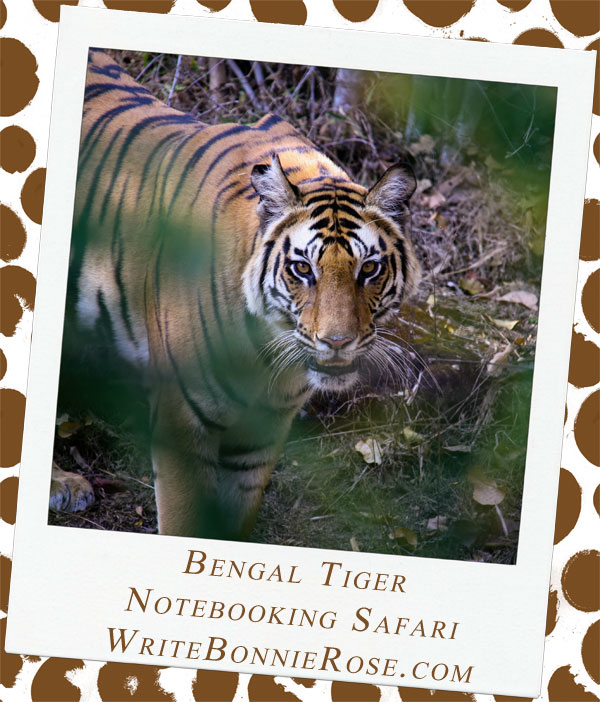
Last week we watched a Bengal tiger in the swamp. Today, let’s go see if we can watch one in the forest. First, we’ll need to spot one—without getting too close!
Look there—in that tall, thick grass. I think I saw something move.
It is! It’s a mother tiger with two cubs. Look and see for yourself. It looks like they are playing. The little ones are rolling back and forth, climbing on top of one another and on top of the mother!
We don’t dare get any closer. A mother tiger will protect her cubs from anything that tries to bother them!
It’s starting to get dark. She’ll go on the hunt soon. Her cubs are still too little to hunt for themselves, so she will go find something that will provide for herself and them. She might bring back a deer or an antelope, a wild pig or a goat, or maybe even a small rhinoceros!
Using the information you find here, answer the following questions:
True or False:
1. A full-grown tiger could be nine feet (2.75 meters) long.
2. You can hear a tiger roar up to two miles away.
3. A tiger usually eats 100 pounds (45 kg) of meat each night.
Research challenge: Do a tiger’s stripes go deeper than its fur coat? In other words, is a tiger’s skin striped, too, or just its fur?
For a free downloadable copy of the entire Asian animals notebooking safari series (31 units total) plus a notebooking page for each one, sign up below.