
• Home
  • My Account
    • Checkout
    • Rewards
  • Subscriber Freebies
  • Journey Through Asia
  • Hidden Village
  • Contact
  • Cart
  • Product Search
  • Nav Social Menu

    • Email
    • Facebook
    • Instagram
    • Pinterest

WriteBonnieRose.com

  • Shop by Subject
    • History, Government & Economics
    • Geography & Social Studies
    • Bible
    • Science, Health & Sports
    • Language Arts
    • Fine Arts
    • Math
    • Preschool
    • Foreign Language
  • Shop by Resource Type
    • Save on Bundles
    • Bite-Sized Topics
    • Coloring Books
    • Copywork
    • Core Resources
    • Critical Thinking
    • Games
    • Hands-On
    • Notebooking
    • Puzzles & Activity Packs
    • Research Projects
    • Stand-Alone
    • Unit Studies
    • Writing Prompts
  • Shop by Age
    • Ages 0-4
    • Ages 5-7
    • Ages 8-10
    • Ages 11-13
    • Ages 14-18
  • Shop by Theme
    • Community Helpers
    • Composers
    • Explorers
    • Holidays & Seasons
    • Inventors
    • Missionaries
    • Sports
    • Transportation
    • U.S. National Parks
  • Shop Newest Titles

Notebooking Safari – Indonesia and Sumatran Rhinoceros

Subscriber Freebies

26 Aug
This entry is part 6 of 31 in the series Notebooking Safari Series

Notebooking Safari Series
  • Notebooking Safari – Russia and the Brown Bear
  • Notebooking Safari – Thailand and the Asian Elephant
  • Notebooking Safari – Vietnam and the Water Buffalo
  • Notebooking Safari – Brunei and Proboscis Monkey
  • Notebooking Safari – Malaysia and the Orangutan
  • Notebooking Safari – Indonesia and Sumatran Rhinoceros
  • Notebooking Safari-India and the Bengal Tiger Part One
  • Notebooking Safari-India and the Bengal Tiger Part Two
  • Notebooking Safari-Singapore and the Crab-Eating Macaque
  • Notebooking Safari-Oman and the Arabian Oryx
  • Notebooking Safari-Burma and the Saltwater Crocodile
  • Notebooking Safari-United Arab Emirates and the Dromedary Camel
  • Notebooking Safari-Qatar and the Dromedary Camel (Part Two)
  • Notebooking Safari-Iraq and the Eurasian Lynx
  • Notebooking Safari-Yemen and the Hamadryas Baboon
  • Notebooking Safari-Bangladesh and the Asian Small-Clawed Otter
  • Notebooking Safari-Israel and the Asian Lion
  • Notebooking Safari Sri Lanka and the Giant Squirrel
  • Notebooking Safari -Kazakhstan and the Snow Leopard
  • Notebooking Safari-Turkey and the Chamois
  • Notebooking Safari-Bahrain and the Lesser Egyptian Jerboa
  • Notebooking Safari-Kyrgyzstan and the Horse
  • Notebooking Safari-Tajikistan and the Markhor
  • Notebooking Safari-Uzbekistan and the Saiga
  • Notebooking Safari-Turkmenistan and the Red Fox
  • Notebooking Safari-Iran and the Ring-Necked Pheasant
  • Notebooking Safari-Afghanistan and the Pamir Argali
  • Notebooking Safari-Pakistan and the Muntjac
  • Notebooking Safari-India and the Wild Yak
  • Notebooking Safari-China and the Bactrian Camel
  • Notebooking Safari-China and the Giant Panda


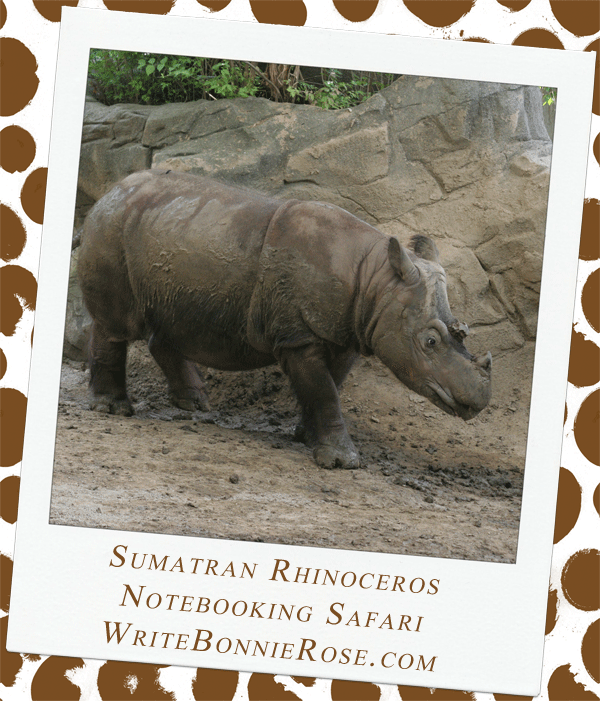
Sumatran rhinoceros safari notebooking page

Our next stop in our notebooking safari across Asia takes us to the Indonesian islands of Kalimantan and Sumatra. If you’re new to the notebooking safari, visit our first stop here.

***

If you’re ready, let’s head over to Sumatra and see if we can spot a very special kind of rhinoceros. There are five species of rhinoceroses living today; the white and the black rhinoceros live in Africa. There are three species of Asian rhinoceroses: the Indian, the Javan, and the Sumatran.

The Sumatran rhinoceros is the smallest species, but it’s not a little animal by any definition! It grows about eight feet (2.5 meters) long, five feet (1.5 meters) tall, and weighs around 1,800 pounds (816.5 kg) or less. That’s not an animal I want to make angry! But when you compare it to the Indian rhinoceros, you’ll see the difference. An Indian rhinoceros is one of the world’s largest land mammals. Only the white rhinoceros of Africa and both African and Asian elephants are larger. The Indian rhinoceros usually grows about eleven feet (3.3 meters) long, seven feet (2.13 meters) high, and weighs between 4,000-6,000 pounds (1.8-2.7 metric tons).

Come on, let’s head out into the forest and see if we can find a Sumatran rhinoceros for you to see up close—well, maybe not too close! There’s a big patch of bamboo about half of a mile from here that is a favorite spot for some of the Sumatran rhinoceroses in this area. If we don’t spot any there, we can climb that ridge you see off to your right and scout around for them. There are some groups of fruit trees up there that I’ve noticed the rhinoceroses like to visit. You wouldn’t think such a large animal could climb the ridge very well, but you’d be wrong! They can climb really well!

I hear something up ahead in the bamboo. Wait—it could be a rhinoceros, but it might be something else. Let’s get back here behind these shrubs, out of the way, and wait to see what comes this way.

Oh—oh, it is! Look at that. It’s the only species of rhinoceros that has hair! Do you see those patches of hair all over its hide? That hair helps the mud stick to its hide when it wallows. The mud keeps it cool and even keeps the insects away!

To see a picture of a Sumatran rhinoceros, click here.

To watch a Sumatran rhinoceros in the wild, click here.

Use this website to answer the following questions:

True or False: 

1. The number of known Sumatran rhinoceroses living today is less than 500.

2. Sumatran rhinoceroses like to live alone.

3. A Sumatran rhinoceros finds others of its kind in the forest by using its sharp eyesight.

Research challenge: You read in the section above that the Sumatran rhinoceros’ hair helps keep the mud caked to their bodies, which helps them stay cool. Why would mud on their bodies make them cooler? 

For a free downloadable copy of the entire Asian animals notebooking safari series (31 units total) plus a notebooking page for each one, sign up below.

Notebooking Safari Series

Notebooking Safari – Malaysia and the Orangutan Notebooking Safari-India and the Bengal Tiger Part One
  • Facebook
  • Twitter
  • Pinterest

Leave a Comment

Previous Post: « Timeline Worksheet: August 25, 1828: Cunningham’s Gap Discovered
Next Post: Bible Story Resource Roundup – Adam and Eve, Noah »

Reader Interactions

Leave a Reply Cancel reply

Your email address will not be published. Required fields are marked *

Primary Sidebar

Subscriber Freebies

Writing Prompts for Teens

Please don't worry that I'll ever spam you or sell your information. Your email address is safe with me, and I'll only share things with you that I support and think might be a blessing to you. You can read my full Privacy Policy for more information.
You’ve successfully signed up! Check your email for details.

Learn About India

Best of WriteBonnieRose on Pinterest

Follow Write Bonnie Rose's board Best of WriteBonnieRose on Pinterest.

Let’s Connect

  • Email
  • Facebook
  • Instagram
  • LinkedIn
  • Pinterest
  • Twitter
Bonnie Rose Hudson


Sponsor a Child in Jesus Name with Compassion

Back to Top | Log in | Branding and Site Setup by Watered Garden Creations.

“He has made everything beautiful in its time. He has also set eternity in the hearts of men;
yet they cannot fathom what God has done from beginning to end.” –Ecclesiastes 3:11 (NIV)

Scripture taken from the HOLY BIBLE, NEW INTERNATIONAL VERSION ®, Copyright ©1973, 1978, 1984 by International Bible Society.
Used by permission of Zondervan. All rights reserved.

WriteBonnieRose, LLC Privacy Policy

COPYRIGHT ©2014-2024, WriteBonnieRose, LLC. ALL RIGHTS RESERVED.

Copyright © 2026 ·Refined Theme · Genesis Framework by StudioPress · WordPress · Log in

Create a new list