
Our next stop in our notebooking safari across Asia takes us to Singapore. If you’re new to the notebooking safari, visit our first stop here.
***
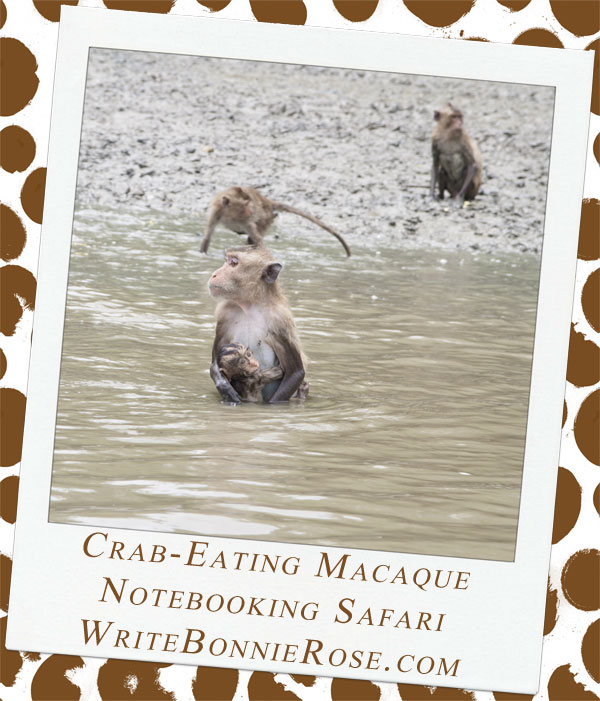
The next animal I want you to see is called a crab-eating (or long-tailed) macaque. There are around twenty different species of macaques, and all but one of them come from Asia. The smallest species is the long-tailed macaque, which is sometimes called the crab-eating macaque. They only grow to weigh around five pounds (2.25 kg) (for the females) to around twelve pounds (5.5 kg) (for the males).
Unlike the proboscis monkey and the orangutan that we’ve met recently, the macaques enjoy both time on the ground and in the trees. They also seem to love getting wet, which would probably come in handy when they are fishing for crabs!
They eat more than crabs, though. They love fruit, and they even eat insects and other small animals. Come on, let’s go down to the water and see if we can spot a troop of macaques!
To watch some crab-eating macaques having some fun in the water, click here.*
*Note to parents: There is offensive language in the comments beneath the video. Please view the video on full screen to avoid displaying the comment section.
Use this website to answer the following questions:
True or False:
1. Young macaques have to be careful of eagles that prey on them.
2. The crab-eating macaque is an endangered species.
3. Their most noticeable characteristics are their long tails.
Research challenge: Macaques in general (not only crab-eating macaques), along with rhesus monkeys, are the types of monkeys most often used in biomedical research. In the 1950s, macaques were used in the development of a vaccine against what disease?
For a free downloadable copy of the entire Asian animals notebooking safari series (31 units total) plus a notebooking page for each one, sign up below.
Leave a Reply