
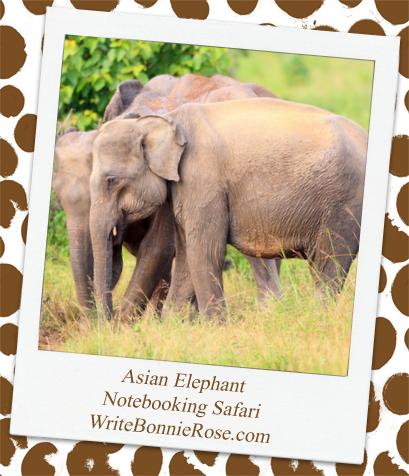
Our next stop in our notebooking safari across Asia takes us to Thailand. If you’re new to the notebooking safari, visit our first stop here.
***
Now, I know you’ve probably seen our next animal before, maybe in a zoo or someplace similar. But, there is so much more to these giant creatures—and their very special trunks—than what you can see at a zoo. That’s right, I’m going to introduce you to an Asian elephant.
There are two main types of elephants—the African and the Asian. One way to tell them apart is by their size. African elephants can be as much as 4,000 pounds (2,000 kg) larger than Asian elephants. African elephants are also known for their huge ears; Asian elephants have smaller, rounder ears.
But, one thing both kinds of elephants have in common is their trunk. The elephant’s trunk is an amazing feature God designed to do all sorts of things! It helps the elephant breathe, drink, eat, smell, and even throw dust on itself (scientists think the elephants like to do that in order to help keep bugs away). It can pick things up off of the ground like fruit. It has all sorts of special jobs, and it contains more than 100,000 muscles to enable it to do them all.
Just about everything an elephant does is BIG! An Asian elephant can eat up to 300 pounds (136 kg) of food every single day!
It’s hard to get the chance to see elephants in the wild in Thailand. So, instead of taking you into the jungle, I’m going to take you to a tourist stop in one of the towns near here. One of my friends owns the elephants there, and I know he takes very good care of them. He doesn’t mistreat his animals.
Elephants used to be very important to the everyday life of people in Thailand. They used them to plow their fields, haul heavy loads, and even to ride on to go places. But, machines slowly started taking those jobs away. The elephants were still really important to the men who logged for a living, but a ban was placed on logging in 1989. After that, most of the elephants were given jobs taking tourists on trips around the countryside.
I’m just glad there are still places we can go to see the Asian elephants. Maybe we’ll even get to go for a ride!
To see a picture of an Asian elephant and to hear one of the sounds an Asian elephant makes, click here.
Use this website to answer the following questions:
True or False:
1. An Asian elephant can use its tusks to strip the bark from trees.
2. A baby elephant lives inside its mother for about three years before being born.
3. After a hard day at work, Asian elephants love to sleep for 7 or 8 hours at night.
4. A baby elephant can weigh about 200 pounds (91 kg) when it is born.
Research challenge: How much water can an Asian elephant drink in one day?
For a free downloadable copy of the entire Asian animals notebooking safari series (31 units total) plus a notebooking page for each one, sign up below.
Leave a Reply