
• Home
  • My Account
    • Checkout
    • Rewards
  • Subscriber Freebies
  • Journey Through Asia
  • Hidden Village
  • Contact
  • Cart
  • Product Search
  • Nav Social Menu

    • Email
    • Facebook
    • Instagram
    • Pinterest

WriteBonnieRose.com

  • Shop by Subject
    • History, Government & Economics
    • Geography & Social Studies
    • Bible
    • Science, Health & Sports
    • Language Arts
    • Fine Arts
    • Math
    • Preschool
    • Foreign Language
  • Shop by Resource Type
    • Save on Bundles
    • Bite-Sized Topics
    • Coloring Books
    • Copywork
    • Core Resources
    • Critical Thinking
    • Games
    • Hands-On
    • Notebooking
    • Puzzles & Activity Packs
    • Research Projects
    • Stand-Alone
    • Unit Studies
    • Writing Prompts
  • Shop by Age
    • Ages 0-4
    • Ages 5-7
    • Ages 8-10
    • Ages 11-13
    • Ages 14-18
  • Shop by Theme
    • Community Helpers
    • Composers
    • Explorers
    • Holidays & Seasons
    • Inventors
    • Missionaries
    • Sports
    • Transportation
    • U.S. National Parks
  • Shop Newest Titles

Notebooking Safari-United Arab Emirates and the Dromedary Camel

Subscriber Freebies

8 Oct
This entry is part 12 of 31 in the series Notebooking Safari Series

Notebooking Safari Series
  • Notebooking Safari – Russia and the Brown Bear
  • Notebooking Safari – Thailand and the Asian Elephant
  • Notebooking Safari – Vietnam and the Water Buffalo
  • Notebooking Safari – Brunei and Proboscis Monkey
  • Notebooking Safari – Malaysia and the Orangutan
  • Notebooking Safari – Indonesia and Sumatran Rhinoceros
  • Notebooking Safari-India and the Bengal Tiger Part One
  • Notebooking Safari-India and the Bengal Tiger Part Two
  • Notebooking Safari-Singapore and the Crab-Eating Macaque
  • Notebooking Safari-Oman and the Arabian Oryx
  • Notebooking Safari-Burma and the Saltwater Crocodile
  • Notebooking Safari-United Arab Emirates and the Dromedary Camel
  • Notebooking Safari-Qatar and the Dromedary Camel (Part Two)
  • Notebooking Safari-Iraq and the Eurasian Lynx
  • Notebooking Safari-Yemen and the Hamadryas Baboon
  • Notebooking Safari-Bangladesh and the Asian Small-Clawed Otter
  • Notebooking Safari-Israel and the Asian Lion
  • Notebooking Safari Sri Lanka and the Giant Squirrel
  • Notebooking Safari -Kazakhstan and the Snow Leopard
  • Notebooking Safari-Turkey and the Chamois
  • Notebooking Safari-Bahrain and the Lesser Egyptian Jerboa
  • Notebooking Safari-Kyrgyzstan and the Horse
  • Notebooking Safari-Tajikistan and the Markhor
  • Notebooking Safari-Uzbekistan and the Saiga
  • Notebooking Safari-Turkmenistan and the Red Fox
  • Notebooking Safari-Iran and the Ring-Necked Pheasant
  • Notebooking Safari-Afghanistan and the Pamir Argali
  • Notebooking Safari-Pakistan and the Muntjac
  • Notebooking Safari-India and the Wild Yak
  • Notebooking Safari-China and the Bactrian Camel
  • Notebooking Safari-China and the Giant Panda

Dromedary Camel Notebooking Page

Our next stop in our notebooking safari across Asia takes us to the United Arab Emirates. If you’re new to the notebooking safari, visit our first stop here.

***

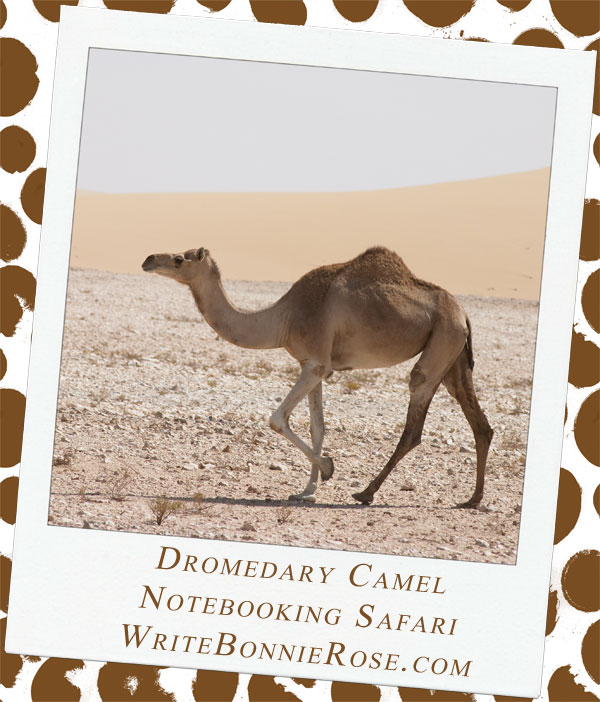
Our next animal is one that I know you’ve heard of before. As a matter of fact, it’s probably the animal you think of first when you think of hot, sandy deserts—a camel! Camels play many important roles throughout the Middle East. People here use them much like people in other nations use horses and cattle. Camels provide a reliable method of transportation, as well as meat, milk, and hides. If it were not for the reliable and hard-working camel, we would not have had the mighty caravans that traveled the Silk Road and other trade routes in Asia.

There are two types of camels, the dromedary (or Arabian) camel and the Bactrian camel. They are easy to tell apart—the dromedary has one hump and the Bactrian has two. They also live in very different places. The Bactrian camel is normally found in Central and East Asia. The dromedary camel is the type you’ll most often find all through the Middle East and Sahara region of Africa.

We don’t have to go far to see a camel. As a matter of fact, I thought you might like the chance to ride on one for yourself. Are you ready? Look, their owner is bringing our rides now!

Why are your eyes getting so big? Oh, you weren’t expecting it to be so big, were you? Camels can grow more than 7 feet (2 meters) tall (at the hump). We’ll have to wait to get on board until the owner has the camel kneel.

OK, are you on board and ready to go? Hold on tight! The rhythm of a camel walking feels a little strange to get used to at first. Instead of moving one front foot and the opposite back foot at the same time, like many animals do, the camel moves both feet on one side of its body then moves both feet on the other side of its body.

The humps that camels are so famous for are critical to their survival in the desert. A dromedary’s hump can store up to 80 pounds (36 kg) of fat that can be broken down into water and nutrients if a camel can’t eat or drink for a long period of time. Trust me, out here in the desert, there are lots of times food and water aren’t easy to find!

I’ll tell you more about the neat ways God equipped the dromedary to thrive out here in the desert next week. We’ll see lots more in the next country we’re going to visit!

To see a picture of a dromedary camel and to hear it for yourself, click here.

Using the information you find here, answer the following questions:

True or False:

1. A thirsty camel can drink up to 30 gallons of water at one time.

2. A camel can go without water for several months.

3. A camel can travel up to 200 miles without a drink.

Research challenge: What happens to a camel’s hump as it uses up the fat stored in its hump? Does it stay the same size? Does it shrink? Does it turn into flab? 

Don’t miss Part Two of our dromedary camel study next week!

For a free downloadable copy of the entire Asian animals notebooking safari series (31 units total) plus a notebooking page for each one, sign up below.

Notebooking Safari Series

Notebooking Safari-Burma and the Saltwater Crocodile Notebooking Safari-Qatar and the Dromedary Camel (Part Two)
  • Facebook
  • Twitter
  • Pinterest

Leave a Comment

Previous Post: « W is for Winning the Lost
Next Post: Timeline Worksheet: October 8, 1871, Peshtigo Fire »

Reader Interactions

Leave a Reply Cancel reply

Your email address will not be published. Required fields are marked *

Primary Sidebar

Subscriber Freebies

Writing Prompts for Teens

Please don't worry that I'll ever spam you or sell your information. Your email address is safe with me, and I'll only share things with you that I support and think might be a blessing to you. You can read my full Privacy Policy for more information.
You’ve successfully signed up! Check your email for details.

Learn About India

Best of WriteBonnieRose on Pinterest

Follow Write Bonnie Rose's board Best of WriteBonnieRose on Pinterest.

Let’s Connect

  • Email
  • Facebook
  • Instagram
  • LinkedIn
  • Pinterest
  • Twitter
Bonnie Rose Hudson


Sponsor a Child in Jesus Name with Compassion

Back to Top | Log in | Branding and Site Setup by Watered Garden Creations.

“He has made everything beautiful in its time. He has also set eternity in the hearts of men;
yet they cannot fathom what God has done from beginning to end.” –Ecclesiastes 3:11 (NIV)

Scripture taken from the HOLY BIBLE, NEW INTERNATIONAL VERSION ®, Copyright ©1973, 1978, 1984 by International Bible Society.
Used by permission of Zondervan. All rights reserved.

WriteBonnieRose, LLC Privacy Policy

COPYRIGHT ©2014-2024, WriteBonnieRose, LLC. ALL RIGHTS RESERVED.

Copyright © 2026 ·Refined Theme · Genesis Framework by StudioPress · WordPress · Log in

Create a new list