
- Notebooking Safari – Russia and the Brown Bear
- Notebooking Safari – Thailand and the Asian Elephant
- Notebooking Safari – Vietnam and the Water Buffalo
- Notebooking Safari – Brunei and Proboscis Monkey
- Notebooking Safari – Malaysia and the Orangutan
- Notebooking Safari – Indonesia and Sumatran Rhinoceros
- Notebooking Safari-India and the Bengal Tiger Part One
- Notebooking Safari-India and the Bengal Tiger Part Two
- Notebooking Safari-Singapore and the Crab-Eating Macaque
- Notebooking Safari-Oman and the Arabian Oryx
- Notebooking Safari-Burma and the Saltwater Crocodile
- Notebooking Safari-United Arab Emirates and the Dromedary Camel
- Notebooking Safari-Qatar and the Dromedary Camel (Part Two)
- Notebooking Safari-Iraq and the Eurasian Lynx
- Notebooking Safari-Yemen and the Hamadryas Baboon
- Notebooking Safari-Bangladesh and the Asian Small-Clawed Otter
- Notebooking Safari-Israel and the Asian Lion
- Notebooking Safari Sri Lanka and the Giant Squirrel
- Notebooking Safari -Kazakhstan and the Snow Leopard
- Notebooking Safari-Turkey and the Chamois
- Notebooking Safari-Bahrain and the Lesser Egyptian Jerboa
- Notebooking Safari-Kyrgyzstan and the Horse
- Notebooking Safari-Tajikistan and the Markhor
- Notebooking Safari-Uzbekistan and the Saiga
- Notebooking Safari-Turkmenistan and the Red Fox
- Notebooking Safari-Iran and the Ring-Necked Pheasant
- Notebooking Safari-Afghanistan and the Pamir Argali
- Notebooking Safari-Pakistan and the Muntjac
- Notebooking Safari-India and the Wild Yak
- Notebooking Safari-China and the Bactrian Camel
- Notebooking Safari-China and the Giant Panda

Our next stop in our notebooking safari across Asia takes us to Uzbekistan. If you’re new to the notebooking safari, visit our first stop here.
***
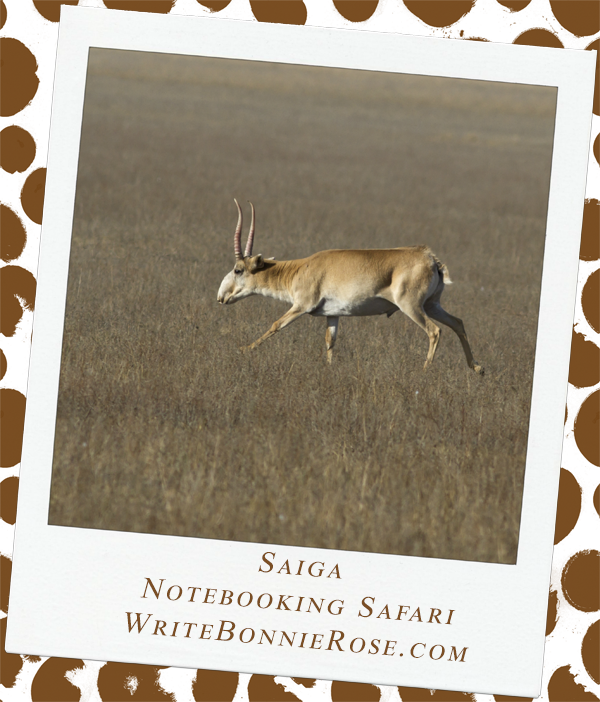
Today I want to show you one of Uzbekistan’s most incredible creatures. It travels to Uzbekistan every winter from Kazakhstan, and it is unlike any animal you have ever seen. Are you ready to go?
There, do you see that animal in the grass? It is about as big as a sheep, and it has short horns. What? You don’t see it? Here, use my binoculars. Now tell me what you see. (Click here.)
That is the saiga; it is a type of antelope. That one is a male; the females don’t have horns. The saiga has a uniquely designed nose. It is long and curved, reaching down over the saiga’s mouth. Scientists think the nose is designed that way to help the saiga breath the dusty air in the summertime and warm the cold air in the wintertime.
Using the information on this page, answer the following questions:
True or False:
- There are millions of saiga in Central Asia; the species is not endangered.
- Its coat is usually brown in the summer and white in the winter.
- The saiga like to travel in large herds when migrating.
Research challenge: What are some of the leading reasons why the saiga population has fallen?
For a free downloadable copy of the entire Asian animals notebooking safari series (31 units total) plus a notebooking page for each one, sign up below.